Tuesday, March 24, 2009

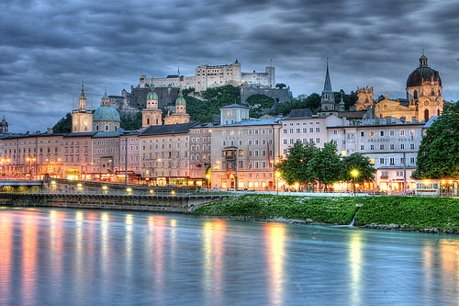
Die Alpen


Not much to say about them, other than you have to see them to believe them. The Alps are quite a thing. I know, not very poignant.
Friday, March 6, 2009

Ein Semester ist vorbei und ein Semester steht uns bevor

Could it be? One semester down, one to go. Yes, winter days in particular can crawl by. But where did the first semester go? I don't know how my students feel about it, but it seems like they had just arrived.

Students come for all kinds of reasons, including ones they don't even know about yet. I walked into a German Club meeting in the fall of 1987 and looked at photos from students who had just come back from Salzburg. I knew I was going to have to go someday, but that wasn't the reason why I was meant to go. I went to Salzburg in June of 1989 to visit friends who'd spent the school year there and knew that I was going to have to go to spend my own year here. But that visit wasn't the reason I was meant to go, either.

As you may have read in my post about Frau Ballwein, I really loved my year 1990-1991 as a student in Salzburg. But it was also so HARD at times. I owned a bike produced during WWII and in one school year had about a dozen flat tires. The Moos-Strasse is a great place to live, but it's not close to anything. So on days when I had no bike, life wasn't good. It meant walking a looong way to the Universität in either the cold, the snow, or most likely: the rain. Historically, Salzburg gets a lot of rain, but that year was particularly bad. They call it "Schnürlregen" in dialect which means "raining in ropes." I destroyed shoes by leaving the house in that rain--it was merciless.

Then, of course, there are relationship issues with people before you meet the person you marry. I mean if every woman was the right one, you'd marry them all, right? That's not allowed in Austria or Maine. Enough said about that.

Then there was the financial side of life. Historically, the kids who take part in this program aren't rolling in dough. They come from families that work hard to make ends meet and do what they can to help their kids out. Whereas students many times work a job or two while they go to school, that option isn't as readily available here. Working officially is, well, illegal and working under the table is, well, illegal. Babysitting and tutoring, things like that, are no big deal. Some of the kids in my group worked many hours at a paper warehouse outside the city packing boxes for shipment. That was probably more on the illegal side of things.

I didn't work at all so I was on a tight budget (ok, I worked one night--I tended a bar at a friend's nightclub in Regensburg on New Year's Eve--I made so much money on tips, I considered quitting school...until someone reminded me that every night is NOT New Year's Eve). I worked at my dining commons at home, but I didn't have that income here. So here I was with no meal plan (they don't do that here), buying my own food (stress), cooking which I'd never really done before (stress), trying to make money last until the end of the month until I got my next installment (stress). I was smart enough to have my family send money in installments because I would've spent like a nut like the rest of my group.

I watched friends have a much harder transition than I did. Three went home within the first three weeks of the semester. Another went home in April. For many different reasons, being here was not what they were meant to be doing. When someone left early, the people left behind went through a period of mourning. We wondered who's going to be next. This despite the wonderful directorship and friendship of Herr and Frau Roggenbauer who were the best Resident Directors a kid could have.

I think I must've been carrying on about my friend who had just gone home in April due to a nervous breakdown when an Austrian woman I'd met in the spring named Klaudia let me have it. I think I was saying, "Why are we here? Why did any of us come?" She told me to get real, that I had chosen a fork in the road that was called Salzburg and there was a reason for it. So what if I didn't know what that reason was in that moment? I might find out the following day or the next year or even further down the road. At the time, that was much too philosophical for my 23-year-old brain. What reason could there possibly be why I was in this city, one that was tough enough to make four of my group go home before they were supposed to?

But I told you in Frau Ballwein's post what my ride was like the day I left. I didn't want to get on the bus that took me to the train, I didn't want to get on the train that took me to the airport. And I didn't want to get on the plane. I didn't want to go home as much as I loved my family and friends. The moment I stopped off the plane, I wished I could rewind my year and start over. I had to go back. But how?

My following year at UMaine was spent much like Christopher Reeve's character at the end of that cheesy movie "Somewhere in Time." Somehow Reeve had propelled himself into the past where he falls in love with Jane Seymour. But when he finds a modern coin in his pocket, he flies through some portal back to present day. Separated from his love, he's absolutely useless until...well, rent the movie!

Anyway, all I could think of was Salzburg and how I had to get back. I was even willing to take a Fulbright Teaching Fellowship in Gmunden, a town an hour-and-a-half away just so I could sometimes travel to Salzburg. Luckily, through a connection with Herr Roggenbauer, a man named Bob O'Donnell, who had in 1985-1986 been a student in the same program also under Roggenbauer, took a chance on me without interviewing me in person. He hired me to be a dorm parent at a boarding school right down the street from where Frau Ballwein lived.

I told the Fulbright people "no thank you" and packed my bags for Salzburg! I was going back! This time to work (legally).

I found myself at my Oma's in Regensburg before heading to Salzburg that first fall. I hadn't seen my new place of work and I was feeling anxious about it. In a way, I felt like I wasn't doing the "grown-up" thing and getting a "real" job. I mean my job description read like a summer camp: play sports with the students, take them on trips.

But I didn't run away. I got on the train a week later to the city I'd been obsessing about for over a year. In Salzburg, I made quickly very good friends with the people I worked with, a couple in fact are life-long friends, the kind you email and talk on the phone with.

It wasn't until my second year at the school in 1993 when I met Jenny. As Forest Gump says in the movie Forest Gump, "My Jenny." Suddenly, all the angst (German word!) about relationships disappeared. I'd had no idea that question my friends and I had always asked, "How do you know if she's the right one?" was answered just by meeting a person. Klaudia, wherever she is now, was right--I'd chosen the fork "Salzburg" for a reason. I had no way of knowing that the reason was waiting for me two years and three months down the road. And we had no way of knowing that little Nikolas would walk (ok, although he's amazing, he couldn't walk when he was born) into our lives close to 12 years later.

Incidentally, in two weeks, Nikolas will have spent his first and his fourth birthdays in Salzburg. How will Salzburg play into his life someday? Hard to say, but it will.

The second semester has begun, and I have four new students to join the other nine students who are part of the 2008-2009 school year. Only time will tell as to why they came. Any fan of the ABC series Lost knows that...everything happens for a reason....

Wednesday, February 18, 2009

A Schloss is not a Schloss is not a Schloss

On Tuesday, I met the mother of one of Nikolas' classmates, Christopher, a six-year-old. Christopher who is very nice and talkative joined the Kindergarten this past November. Among all the things he told me after I'd met his mother was how much he loved Salzburg's Schloss or castle. Now technically, Salzburg has several castles and the building in the city center is NOT a castle, but instead a fortification, a "Festung." But come on, to a kid and to most adults, it's a bloody castle.

One thing he shared with me that his mother probably didn't want him to dwell on was that "It's expensive to get into the castle." It is true that there's an entrance to the fortress grounds which offer great views. The actual inside of the fortress is interesting, too, but if you're able to walk around up there, it's as good as being inside. But what is also true, which I then shared with Christopher's mother, is that residents of Salzburg are allowed in for free! All you have to say is that you LIVE in Salzburg, and the man behind the counter hands you receipts that say you paid €0.00 to get in. She and her son were very happy to hear this as you might imagine.

Conversely, there's Windsor Castle in Windsor, where, yes, the Queen lives. When we lived in England in the 1990s, we often went to Windsor but NEVER went into the Castle. It was just too expensive, although I don't remember what it cost at the time. Now we're here again, this time with Nikolas, who also likes castles (and what he calls "castle fighters), fortresses, etcetera, etcetera. But we won't be going to Windsor Castle. A "Family Pass" costs no less than €41 ($52). After researching several palaces and fortresses this year in thinking of places to take my students, I'm so used to seeing entrance prices in the range of €7 ($9) to think that it's a good idea to pay that kind of money. By comparison, the Festung's Family Pass is €17 ($21).

We'll probably go to Windsor this week and, like in the 1990s, we'll probably see lines to get into the Castle, but we won't be among the masses. Sorry, Your Majesty, but I don't get it.

Der Bankomat

European ATMs know where it's at. Or at least the people who program them do.

First off, they acknowledge that no one in the world withdraws cents from an ATM, so you never have to type in the two zeros after the decimal point. If you want 50 euros, you simply type in 5 and then 0. Done.

Also, a European ATM gives you your money only AFTER it has spat out your bank card. This is great! That means the only way you'd ever walk away from a machine without your card is if you also walked away without getting your money. Not likely to happen. So it spits out your card, then comes your money. In the U.S., my bank always asks me (after my money's come out) if I want to do something else while my card is still in the ATM. What else would I want to do? Put the money I just got out back in?

Wednesday, February 11, 2009

Antalya

In the 1st century BC, King Attalus II of Pergamon ordered his men to find the most beautiful piece of land on earth -- “Heaven on Earth”. After a long search, they discovered a place with sea and mountains and palm trees and considered it to be heavenly. It was there that King Attalus founded the city of Antayla (then called Attaleia). Today Antalya is a modern city of over a million people with a well-preserved old city, still surrounded by an ancient wall.

Today we went on an outing to Antalya. We hopped on the hotel shuttle that dropped us on the side of a street, seemingly nowhere, but once we got our bearings turned out to be just down the street from Hadrian’s Gate. The gate was built into the city wall after Hadrian’s visit to the city in 130 AD (the same Hadrian who has the wall in Northern England). Next to the gate is a small park, filled with benches and men sipping tea. There is even a park tea waiter to bring them their tea!

Walking through the gate you enter the old city with its narrow alleyways and ancient buildings. There are many souvenir shops, and almost everyone has “a special price for you, my friend”. The salesmen aren’t pushy, however, and take no for an answer easily. We were only suckered in once by a man at a spice stand who asked Peter if he was going for the Turkish look with his unshaven stubbly chin. It was a good laugh, as most of the men had the same unshaven stubble. From there, glasses of tea were made – one pomegranate and one apple – scoops of drink mix being taken from among the trays of spices. Nikolas gave it the thumbs up, and so we felt compelled to buy some.

We continued our walk down to the harbor past souvenir stands, pottery shops (with little old ladies inside painting pots), rug shops and little restaurants. The harbor is nestled in a cove surrounded by a cliff, and you can imagine ancient ships coming and going. There were plenty of people offering boat rides for a great price, but we didn’t have the time. It was a great mix of tourist site and real life, with fishermen working on their nets, a motorcycle being washed, and people working on their boats.

During a mediocre lunch at a restaurant sitting on spectacular site overlooking the sea and the mountains, the call to prayer came echoing from somewhere in the distance. Ninety-nine percent of the people in Turkey are Muslim, although the government has a secular constitution, providing for freedom of religion. Still, there are mosques everywhere and the call to prayer comes over loudspeakers on the pointed towers of every mosque five times a day.

Before too long, it was time to head back to the shuttle, a great outing coming to an end too soon. Antalya is a beautiful city, with much more to explore than we did. More pictures will be posted on the blog once we’re back in Salzburg, and you will be able to see them here.

Sunday, January 25, 2009

Spending money the old fashioned way--actually having it!

We recently booked our February trip (vacations from school for all of us) at the travel agency--7 days in Antalya, Turkey. When Frau Fiebrisch was finally finished typing in all of our details, she gave me the final price. I took out our Visa card and handed it to her. She looked at the card, then looked up at me, and I just knew there was an issue.

"We don't accept credit cards, only cash."

When booking a family weekend for March, the answer was the same. Luckily, we've saved for vacations this year, so it's not much of an issue.

I think if an established business in the U.S. tells us that they can't take credit cards, we wonder right away if they're legit. At least in Germany and Europe, taking cash only is still quite common.

Now when people say "only cash," they're not assuming that you're willing to carry hundreds or thousands of Euros on your person. Debit cards are the rage here. Regardless, one thing is for certain: you need to actually have the money in order to buy many things. Not really a bad way to go when you think about it.

I've seen a couple of articles in the paper in Salzburg about people getting into credit card debt troubles, but compared to what we read about in the States, it's almost laughable. In Austria, if you're carrying $2,500 in debt, you're considered to be on the brink of financial collapse.

Salzburg is actually not the norm when it comes to credit card acceptance. Most restaurants here do take cards but it's mostly because of the number of tourists that come through the city. In a city like Regensburg in Southern Germany, for example, you can really be hard pressed to use plastic.

Perhaps they have something here, though. It's not a bad idea to save up for something like a vacation. I used to read Mutual Funds Magazine. They always published financial advice, and when they'd run out of things to say, it seems like they always returned to the axiom, "Never borrow to take a vacation, save up for it instead."

Companies here who don't take cards will tell you why they don't take cards. It's not because they want us to be better with our money. It's because they don't want to pay the credit card companies up to 6% in fees for allowing you to use a card.

When you think about it, not using credit cards can only mean more money for us, the consumer. First, we don't have to pay finance charges for carrying a balance on the card. Second, business may not feel the need to raise prices to compensate for the 6% in credit card charges. Third, if it's a vacation you're talking about, what better feeling is there than coming back from a vacation not worrying about how you're going to now pay for it. At what point, in the USA, did we lose sight of that concept?

Friday, January 16, 2009

Frau Ballwein

In 1990, I moved to Salzburg to study for the year as a participant in the same program I'm leading for the year. Back in the day, we showed up without a place to stay and simply starting knocking on the doors of houses with private rooms where former participants had lived before us. Today, this is almost unheard of. Students live in dorms and thanks to the Internet, they can apply and be accepted months before they even start to think about packing their bags.

Anyway, I spent my first day in Salzburg calling places on my list only to be told that I was out of luck. I'd plotted the streets out on my Salzburg city map and was calling all the centrally-located places first. After a number of calls and visits, I was now looking at Frau Ballwein's telephone number. She lived out on the Moosstrasse, a five-kilometer-long street. I wasn't sure where number 63 was, but it probably wasn't at the start of Moosstrasse, which is very close to the city center, and it probably wasn't out in Glanegg, the very next town outside Salzburg.

As it turns out, it's about three kilometers down the street, and I ended up walking the entire thing that day. I mistakenly got out of the bus at the start of the street because the busstop announced was "Moosstrasse." As soon as I got of bus, what did it do? It turned down Moosstrasse and kept on going.

I'd called Frau Ballwein on the phone and she told me to come by at 5 p.m. So at about 5:20 I showed up hot and sweaty, hoping I wasn't late. She was in the driveway ironing some clothes, electrical cord strung out of her kitchen window. We spoke for awhile about the room she had but I couldn't see it because someone was living in there until the end of the month. It was the equivalent of $250 (2,500 Austrian Schillings). I said "Yes!" because I didn't want to go back to the hostel that night worried that I had no place to stay for the year. Two other American guys were already living in the house. So I was already breaking one of my pre-Salzburg rules--that I'd live alone or with Austrians only. Again, I just wanted a place to live.

Frau Ballwein was 67 years old but she was tough! She could carry wood, mow grass with a sickle (if you've every tried, it's HARD!), milk cows, cook like a madwoman, tow a wagon full of hay, and build things with wood, hammer, and nails. "Old school" doesn't describe Frau Ballwein. She built the school.

The three guys lived in one part of the house with our own entrance. There was a door to her part of the house in our kitchen, but it was understood that she could use it to get through our part to go to go behind the house. But we weren't to go into her part of the house.

But after a short time there, Frau Ballwein started inviting us in for a meal here or there. The first time it was to make us American french toast. Some girls who'd lived with her before us had taught her how to make it. Frau Ballwein was blunt, though, and as we sat down to our perfectly made french toast, she told us that her cat had been squashed the night before by a truck. Flat as a pancake, it was.

Then the first Gulf War began. Frau Ballwein invited us in nightly to watch the news and we welcomed it. There was no central heat in that house. We each had a space heater in our rooms, but it was common for us to pop fuses because we were all trying to stay warm. Her living room was nice and toasty though because the kitchen and living room shared a Kachelofen. Unlucky for us, American involvement in the first Gulf War only lasted about a month or so, so we thought we'd been relegated back to the our much cooler rooms. Nope, Frau Ballwein told us that if we wanted to watch TV with her, we could just knock on her door.

Frau Ballwein told us one day in passing that in her 67 year on the planet, she'd never taken a vacation. We practically fell out of our chairs. As a farmer, she saw herself on duty seven days a week. She said, "Cows don't take a break from eating and milking and going to the bathroom." We pleaded with her to consider taking a vacation--she certainly deserved one! After several weeks of planning, Frau Ballwein went with two of her cousins on a four-week Kur, basically a rest and relaxation spa that is covered by insurance. Technically, it wasn't a vacation in the strictest sense, but good enough. We missed Frau Ballwein and we missed watching TV in her part of the house. However, in exchange for feeding her chickens our leftover scraps from our meals, we were allowed to go into the hen house and keep the eggs. One night we were starving, so we took our flashlights into the hen house to see if any hens had laid some late-night eggs. No luck, and the hens were furious that we'd even try this.

The day I left Salzburg that year, I was a nervous wreck. I knew I was leaving a place I didn't want to leave. And I had to say "good-bye" to Frau Ballwein. My other two housemates were gone. Geoff had left a week early and Jim was in the hospital over an hour away with serious tetanus (the last I saw of Jim was at a Sting concert in Linz--he told me he had to go sit down and I never saw him again...that year--I've seen him since). Frau Ballwein made me a cup of coffee and set out some bread and jam. She knew that my place was cleaned out including the refrigerator. I couldn't control my hands--I was shaking like a clown. She noticed and just said, "It's not like you're never coming back."

When the bus came, I gave her a hug and she reciprocated with one of those, ok-get-on-the-bus hugs. My ride down the Moosstrasse was embarrassing. I sat among a group of senior citizens who were also riding into town. I was crying like child, and soon the old ladies around me were all teary-eyed.

But Frau Ballwein was right. I did go back. I went back for two more years and worked right down the street from where Frau Ballwein lived. Without Frau Ballwein, there wouldn't be the OTHER cat story which I'll save for another blog, even though this one is short. I saw Frau Ballwein years later well into the 2000s. Even two of my Pennington School groups got to meet her when we stayed at her son's bed & breakfast.

The last time I saw her was in March of 2006 and like every year, I sent her a Christmas card at the end of the year. Her youngest son wrote me back at the beginning of 2007 with a nice note and Frau Ballwein's death notice. I'd known she'd been battling cancer for close to three years, but she was tough. But at 82, the cancer was tougher and she died peacefully with her family around her: sons and their wives, grandchildren, and great-grandchildren.

Today, I visited Frau Ballwein for probably the last time. She's located in the small cemetery behind the church on the Moosstrasse. Her son's farmhouse and bed & breakfast is a short distance across the field. She's lying with her husband who she survived by almost 20 years! To be honest, I didn't get choked up--she wouldn't have wanted that anyway.