In 1990, I moved to Salzburg to study for the year as a participant in the same program I'm leading for the year. Back in the day, we showed up without a place to stay and simply starting knocking on the doors of houses with private rooms where former participants had lived before us. Today, this is almost unheard of. Students live in dorms and thanks to the Internet, they can apply and be accepted months before they even start to think about packing their bags.
Anyway, I spent my first day in Salzburg calling places on my list only to be told that I was out of luck. I'd plotted the streets out on my Salzburg city map and was calling all the centrally-located places first. After a number of calls and visits, I was now looking at Frau Ballwein's telephone number. She lived out on the Moosstrasse, a five-kilometer-long street. I wasn't sure where number 63 was, but it probably wasn't at the start of Moosstrasse, which is very close to the city center, and it probably wasn't out in Glanegg, the very next town outside Salzburg.
As it turns out, it's about three kilometers down the street, and I ended up walking the entire thing that day. I mistakenly got out of the bus at the start of the street because the busstop announced was "Moosstrasse." As soon as I got of bus, what did it do? It turned down Moosstrasse and kept on going.
I'd called Frau Ballwein on the phone and she told me to come by at 5 p.m. So at about 5:20 I showed up hot and sweaty, hoping I wasn't late. She was in the driveway ironing some clothes, electrical cord strung out of her kitchen window. We spoke for awhile about the room she had but I couldn't see it because someone was living in there until the end of the month. It was the equivalent of $250 (2,500 Austrian Schillings). I said "Yes!" because I didn't want to go back to the hostel that night worried that I had no place to stay for the year. Two other American guys were already living in the house. So I was already breaking one of my pre-Salzburg rules--that I'd live alone or with Austrians only. Again, I just wanted a place to live.
Frau Ballwein was 67 years old but she was tough! She could carry wood, mow grass with a sickle (if you've every tried, it's HARD!), milk cows, cook like a madwoman, tow a wagon full of hay, and build things with wood, hammer, and nails. "Old school" doesn't describe Frau Ballwein. She built the school.
The three guys lived in one part of the house with our own entrance. There was a door to her part of the house in our kitchen, but it was understood that she could use it to get through our part to go to go behind the house. But we weren't to go into her part of the house.
But after a short time there, Frau Ballwein started inviting us in for a meal here or there. The first time it was to make us American french toast. Some girls who'd lived with her before us had taught her how to make it. Frau Ballwein was blunt, though, and as we sat down to our perfectly made french toast, she told us that her cat had been squashed the night before by a truck. Flat as a pancake, it was.
Then the first Gulf War began. Frau Ballwein invited us in nightly to watch the news and we welcomed it. There was no central heat in that house. We each had a space heater in our rooms, but it was common for us to pop fuses because we were all trying to stay warm. Her living room was nice and toasty though because the kitchen and living room shared a
Kachelofen. Unlucky for us, American involvement in the first Gulf War only lasted about a month or so, so we thought we'd been relegated back to the our much cooler rooms. Nope, Frau Ballwein told us that if we wanted to watch TV with her, we could just knock on her door.
Frau Ballwein told us one day in passing that in her 67 year on the planet, she'd never taken a vacation. We practically fell out of our chairs. As a farmer, she saw herself on duty seven days a week. She said, "Cows don't take a break from eating and milking and going to the bathroom." We pleaded with her to consider taking a vacation--she certainly deserved one! After several weeks of planning, Frau Ballwein went with two of her cousins on a four-week Kur, basically a rest and relaxation spa that is covered by insurance. Technically, it wasn't a vacation in the strictest sense, but good enough. We missed Frau Ballwein and we missed watching TV in her part of the house. However, in exchange for feeding her chickens our leftover scraps from our meals, we were allowed to go into the hen house and keep the eggs. One night we were starving, so we took our flashlights into the hen house to see if any hens had laid some late-night eggs. No luck, and the hens were furious that we'd even try this.
The day I left Salzburg that year, I was a nervous wreck. I knew I was leaving a place I didn't want to leave. And I had to say "good-bye" to Frau Ballwein. My other two housemates were gone. Geoff had left a week early and Jim was in the hospital over an hour away with serious tetanus (the last I saw of Jim was at a Sting concert in Linz--he told me he had to go sit down and I never saw him again...that year--I've seen him since). Frau Ballwein made me a cup of coffee and set out some bread and jam. She knew that my place was cleaned out including the refrigerator. I couldn't control my hands--I was shaking like a clown. She noticed and just said, "It's not like you're never coming back."
When the bus came, I gave her a hug and she reciprocated with one of those, ok-get-on-the-bus hugs. My ride down the Moosstrasse was embarrassing. I sat among a group of senior citizens who were also riding into town. I was crying like child, and soon the old ladies around me were all teary-eyed.
But Frau Ballwein was right. I did go back. I went back for two more years and worked right down the street from where Frau Ballwein lived. Without Frau Ballwein, there wouldn't be the OTHER cat story which I'll save for another blog, even though this one is short. I saw Frau Ballwein years later well into the 2000s. Even two of my Pennington School groups got to meet her when we stayed at her son's bed & breakfast.

The last time I saw her was in March of 2006 and like every year, I sent her a Christmas card at the end of the year. Her youngest son wrote me back at the beginning of 2007 with a nice note and Frau Ballwein's death notice. I'd known she'd been battling cancer for close to three years, but she was tough. But at 82, the cancer was tougher and she died peacefully with her family around her: sons and their wives, grandchildren, and great-grandchildren.
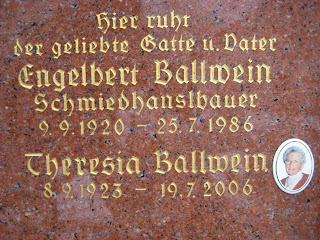
Today, I visited Frau Ballwein for probably the last time. She's located in the small cemetery behind the church on the Moosstrasse. Her son's farmhouse and bed & breakfast is a short distance across the field. She's lying with her husband who she survived by almost 20 years! To be honest, I didn't get choked up--she wouldn't have wanted that anyway.

 On Tuesday, I met the mother of one of Nikolas' classmates, Christopher, a six-year-old. Christopher who is very nice and talkative joined the Kindergarten this past November. Among all the things he told me after I'd met his mother was how much he loved Salzburg's Schloss or castle. Now technically, Salzburg has several castles and the building in the city center is NOT a castle, but instead a fortification, a "Festung." But come on, to a kid and to most adults, it's a bloody castle.
 Conversely, there's Windsor Castle in Windsor, where, yes, the Queen lives. When we lived in England in the 1990s, we often went to Windsor but NEVER went into the Castle. It was just too expensive, although I don't remember what it cost at the time. Now we're here again, this time with Nikolas, who also likes castles (and what he calls "castle fighters), fortresses, etcetera, etcetera. But we won't be going to Windsor Castle. A "Family Pass" costs no less than €41 ($52). After researching several palaces and fortresses this year in thinking of places to take my students, I'm so used to seeing entrance prices in the range of €7 ($9) to think that it's a good idea to pay that kind of money. By comparison, the Festung's Family Pass is €17 ($21).


